
What is TB500? TB-500 is a synthetic peptide built around the actin-binding region of thymosin beta 4 (Tβ4), a protein made naturally in most human cells. It is studied for cell migration, wound repair and new blood vessel growth, almost entirely in animals and cells, and it is not FDA-approved for any use.
That is the short answer. The longer one matters, because a lot of what you read online blurs TB-500 with the full natural protein, overstates the human evidence and skips the legal and sporting rules. This pillar guide covers what TB-500 is, how it works at the cell level, what it has been studied for, how strong that evidence really is, where it stands with the FDA and WADA, and how people access it through a prescription today.
Also searched as: what is tb 500, tb 500 peptide, tb500 peptide, tb-500, tb 500, tb4 peptide, thymosin beta 4.
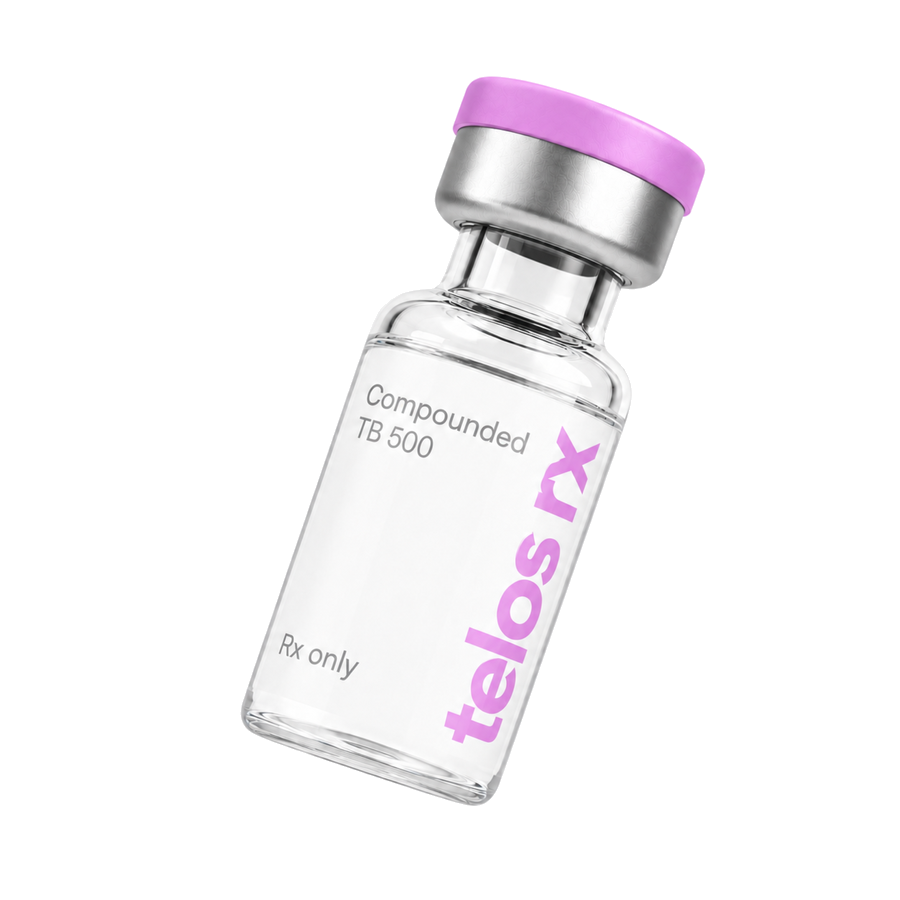
What is TB500, exactly?
Start with the parent molecule. Thymosin beta 4 is a 43-amino-acid protein found inside most of your cells. Its main known job is to bind single units of actin, the protein that cells use to build their internal scaffolding and to move. Researchers showed decades ago that Tβ4 holds on to free actin units and keeps them from joining into filaments until the cell needs them, a role called actin sequestration (Cassimeris 1992).
TB-500 is not that whole protein. A racing laboratory study that developed a test for it describes TB-500 as a veterinary preparation whose key ingredient is the short sequence LKKTETQ, with an acetyl group added, taken from positions 17 to 23 of thymosin beta 4. That segment is the part linked to actin binding, cell migration and wound healing (Ho 2012).
So when someone asks "what is TB500?", the accurate reply is: a small synthetic fragment, or analog, of a natural protein, designed around the protein's most active region. It is sometimes loosely called the "TB4 peptide", but TB-500 and full Tβ4 are different molecules. We break the differences down in TB-500 vs thymosin beta 4.
telos rx prescribes TB-500 only as part of the compounded BPC-157 + TB-500 stack, after an online review by a US-licensed provider. telos rx does not offer TB-500 on its own.
See if the BPC-157 + TB-500 stack is right for youHow the TB-500 peptide works: actin, movement and new vessels
A useful way to picture it: when tissue is damaged, cells near the injury have to crawl toward it. Crawling depends on actin being assembled and taken apart quickly at the cell's leading edge. Tβ4 acts like a holding pool for loose actin, which helps the cell manage that process. It does not "boost actin production", a claim you will still see on some sites.
Beyond actin, Tβ4 has been studied for other signals. In a widely cited mouse study, Tβ4 formed a complex with a survival enzyme pathway (integrin-linked kinase and Akt) in heart muscle cells and supported cell migration and survival after an induced heart injury (Bock-Marquette 2004). A review of the field describes Tβ4 as released by platelets and immune cells after injury and studied for cell migration, new blood vessel growth (angiogenesis) and reduced scarring (Goldstein 2012).
Important caveat: nearly all of this was done with full Tβ4, not the TB-500 fragment. Whether the fragment reproduces each effect in people is unknown. For the detailed science, read our TB-500 mechanism of action explainer.
What is TB500 studied for?
Here is a quick map of the main research areas and the type of evidence behind each one. It answers the practical side of "what is TB500 studied for" without implying any of it works in you.
| Research area | What was studied | Evidence type |
|---|---|---|
| Skin wounds | Full Tβ4 applied to wounds in rats (Malinda 1999) | Animal; small phase 2 human trials of topical Tβ4 |
| Tendon | TB-500 after Achilles tendon repair in rats (Biçer 2026) | Animal, one small exploratory study |
| Heart tissue | Full Tβ4 after induced heart injury in mice | Animal |
| Hair follicles | Full Tβ4 and hair growth in rats and mice (Philp 2004) | Animal |
| Eye surface | Tβ4 eye drops for dry eye (Sosne 2015) | Human phase 2, topical Tβ4, primary endpoints not met |
Notice the pattern. The human trials that exist used topical, full-length Tβ4 for skin or eyes. None tested injected TB-500 for muscle, joint or sports recovery. We grade each claimed benefit, one by one, in our sibling guide to TB-500 benefits and the research.
How strong is the evidence? An honest answer
If you are asking what is TB500 good for in humans, the truthful answer is that nobody knows yet. There are no published controlled trials of injected TB-500 in people. Online "results" come from anecdotes, which cannot separate the peptide from rest, rehab, time or expectation.
Even the newest animal work is cautious. The 2026 rat tendon study found better tissue scores and strength at four weeks with TB-500 than with no treatment, but it was small, exploratory, and the authors called for more dose and long-term research. It also found that combining TB-500 with BPC-157 gave no extra benefit over either one alone in that model (Biçer 2026). That is one rat study, not a reason to expect a result.
Older overviews on this site, including our TB-500 tissue repair research overview, go deeper into individual preclinical papers.
Curious whether a provider would consider the stack for you? The intake is online and asynchronous, with no scheduled appointment, and every prescription is subject to medical approval by a licensed provider.
Start your provider reviewWhat is TB500's legal and FDA status?
TB-500 is not FDA-approved for any use. In July 2026 (23 to 24 July), the FDA's Pharmacy Compounding Advisory Committee voted 8 for, 6 against, with 1 abstention, to recommend adding TB-500 to the list of bulk substances that can be used in compounding. FDA's own briefing documents had recommended against.
That vote was advisory and non-binding. On October 28, 2026, HHS announced an interim enforcement discretion policy for six peptides, TB-500 among them. HHS does not intend to take enforcement action against state-licensed pharmacies or licensed physicians that compound TB-500 with a valid prescription, as long as strict conditions are met, including FDA-registered suppliers, lot-level testing, adverse event reporting and a single-ingredient product given by subcutaneous or intramuscular injection. The policy covers each peptide as a single-ingredient product, so it does not cover a blend of BPC-157 and TB-500 in one product. The telos rx stack is supplied as two separate vials, so neither vial is a blend. The policy is temporary while FDA decides through rulemaking, it is not FDA approval, and HHS can revisit it. Our full breakdown is in TB-500 regulatory status after the PCAC vote.
WADA and drug testing
TB-500 is on the WADA Prohibited List at all times: under S0 as a non-approved substance and also under S2 as a growth factor. Laboratories have published methods to detect it and its breakdown products, starting in racehorses (Ho 2012). If you compete in any tested sport, do not use it.
Safety basics
Reported or theorised side effects include injection-site reactions, headache, nausea, dizziness, fatigue and flushing. Long-term human safety is not established. Because Tβ4 is studied for blood vessel growth, people with cancer or a history of cancer are commonly advised to avoid it, and it is not for use in pregnancy or breastfeeding. A provider makes that call. More in TB-500 side effects: 7 things to know.
What is TB500 access like today?
There are two very different markets. One is grey-market vials labelled "research use only". These are not made for human use, and their contents are unverified: contamination, wrong dose and even the wrong compound are real risks. The other is a prescription, written after a licensed provider reviews your health history and filled by a licensed US pharmacy.
At telos rx, TB-500 is available only one way: inside the compounded BPC-157 + TB-500 stack, sometimes called the Wolverine stack. telos rx does not offer TB-500 on its own. Here is how it works:
- Online intake. You answer health questions, including cancer history and medications.
- Asynchronous provider review. A US-licensed provider reviews it, with no scheduled appointment. A prescription is required and approval is not guaranteed.
- Licensed pharmacy. If approved, a licensed US pharmacy compounds the stack as two separate single-ingredient vials, each ready to inject at the prescribed dose, under one provider-set plan.
- Ongoing support. Secure messaging with the care team, and plans can be paused or cancelled.
The stack is $133 per month. To understand why the two peptides are paired, see the Wolverine stack explained, and for how dosing decisions are made, our planned guide on how providers dose TB-500. Full details are on the BPC-157 + TB-500 stack page.
Frequently asked questions
What is TB500 in simple terms?
TB-500 is a lab-made peptide modelled on the actin-binding region of thymosin beta 4, a protein your cells already make. It is studied for cell migration, wound repair and new blood vessel growth, mostly in animals and cells. It is not FDA-approved for any use.
Is TB 500 the same as thymosin beta 4?
No. Thymosin beta 4 is the full 43-amino-acid natural protein. TB-500 is a much shorter synthetic analog built around its active actin-binding segment. Most published research is on full thymosin beta 4, not on TB-500 itself.
What is TB500 used for in research?
Researchers have studied the parent protein, thymosin beta 4, for skin wound repair, heart tissue after injury in mice, hair follicle activity in rodents, eye surface repair and tendon repair in rats. Human data on TB-500 itself are essentially absent.
Is the TB-500 peptide legal?
TB-500 is not FDA-approved. In July 2026 an FDA advisory committee voted to recommend adding it to the list of bulk substances that can be used in compounding. On October 28, 2026, HHS announced a temporary enforcement discretion policy covering compounded single-ingredient TB-500 injections under strict conditions while FDA completes rulemaking. It is not FDA approval and HHS can revisit it.
Is TB-500 banned in sport?
Yes. TB-500 is on the WADA Prohibited List at all times, both as a non-approved substance and under the growth factor category. Tested athletes should not use it, and racing laboratories have published methods to detect it.
Can I get the TB4 peptide on its own from telos rx?
No. telos rx does not offer TB-500 on its own. It is only available as part of the compounded BPC-157 + TB-500 stack, and only after an online review by a US-licensed provider. Approval is not guaranteed.
What is TB500 side effect risk?
Reported or theorised effects include injection-site reactions, headache, nausea, dizziness, fatigue and flushing. Long-term human safety is not established. Because thymosin beta 4 is studied for blood vessel growth, people with cancer or a cancer history are commonly advised to avoid it.
Want a licensed provider's view on the BPC-157 + TB-500 stack? Start the online intake. telos rx does not offer TB-500 on its own, and approval is not guaranteed.
See if the BPC-157 + TB-500 stack is right for youThis article is for general education and is not medical advice. TB-500 and BPC-157 are not FDA-approved for any use, and compounded medications are not FDA-approved. All prescriptions are subject to medical approval by a licensed provider; approval is not guaranteed. TB-500 is prohibited by WADA at all times. Individual experiences vary. telos rx is an online-first, asynchronous telehealth service, and medications are compounded by a licensed US pharmacy.