
There is no established KPV dosage for people. KPV has only been studied in cells and animals, so any dose you see online is a guess, not a number from human trials. If KPV is prescribed, a licensed provider sets the dose, form and schedule for you.
Search for KPV dosage and you will find confident charts, forum threads and calculators that all disagree. This guide explains why. It covers what the animal research actually used, why online KPV dosing numbers vary so much, and how a provider approaches the decision. It does not give you a dose to follow, because no evidence-based one exists.
Also searched as: kpv dose, kpv dosing, kpv peptide dosage, peptide kpv dose.
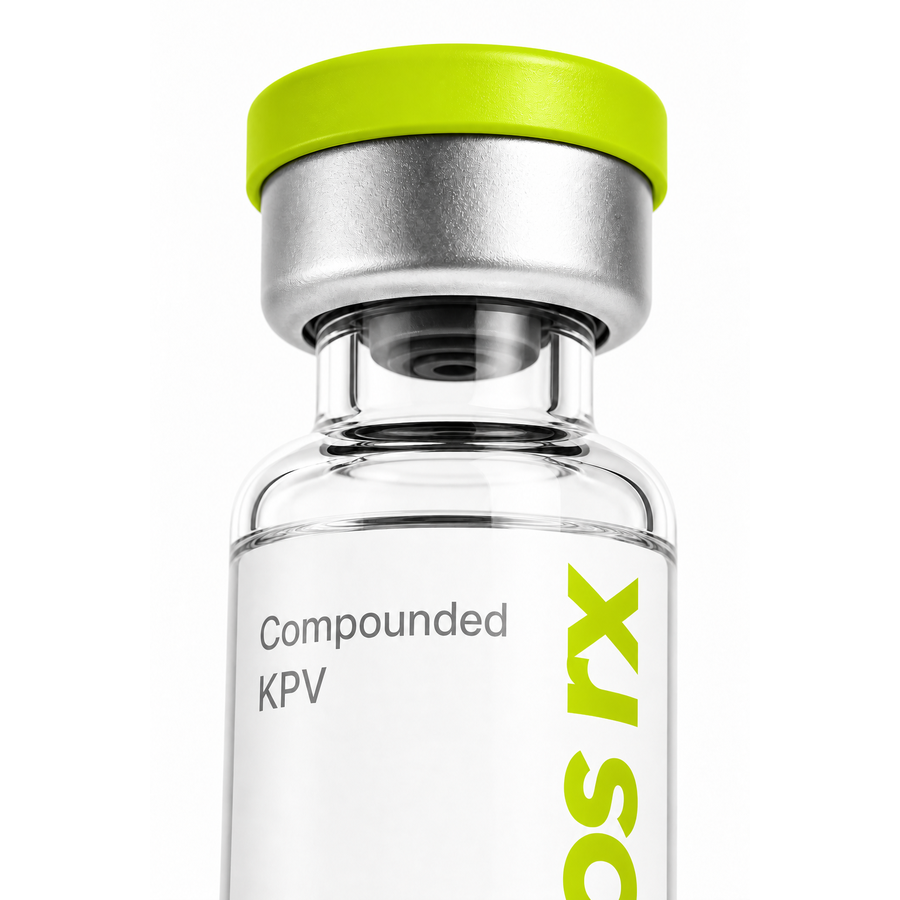
What is KPV, and why does dosage matter?
KPV is a tripeptide, a chain of just three amino acids: lysine, proline and valine. It is the tail end, positions 11 to 13, of a hormone called alpha-melanocyte-stimulating hormone, or alpha-MSH (Kannengiesser et al., 2008, Inflammatory Bowel Diseases). Researchers study KPV peptides like this one for their effects on inflammatory signalling.
Our explainer on what the KPV peptide is covers the basics, and our review of KPV anti-inflammatory research goes deeper into the science. Here, the focus is narrower: the question of KPV dosage.
Dose matters for any active substance. Too little may do nothing. Too much may raise the chance of side effects. For KPV, the honest problem is that nobody has mapped that range in people.
Want a licensed provider to look at KPV for you, instead of guessing from a chart? Complete a short online intake. A US-licensed provider reviews it asynchronously, with no scheduled appointment, and decides whether KPV is appropriate.
See if KPV is right for youIs there an established human KPV dosage?
No. We searched PubMed for controlled human trials of KPV and found none published. KPV is not FDA-approved for any use, and it has no approved label, so there is no official KPV dosage to point to.
That means every KPV dose you read about online falls into one of three groups:
- Numbers borrowed from animal studies, often converted to humans with rough maths that does not hold up.
- Numbers printed by grey-market sellers, whose products are sold as "research use only" and whose quality is unverified.
- Personal experiments shared on forums, which describe one person's choices, not evidence.
None of these is a reliable basis for KPV dosing. That is the single most important point in this article.
What KPV dosage did animal studies use?
Most KPV research is in mouse models of colitis, a type of gut inflammation. Here is what the published studies describe. These are research protocols in mice, described for context only. They are not a human KPV dosage and should not be converted into one.
| Study | Model | How KPV was given |
|---|---|---|
| Dalmasso et al., 2008 | Human gut and immune cells; two mouse colitis models | Nanomolar concentrations in cells; added to drinking water in mice |
| Viennois et al., 2016 | Mouse model of colitis-associated tumours | 100 micromoles per litre in drinking water |
| Laroui et al., 2010 | Mouse colitis model | Loaded into nanoparticles inside a gel, taken by mouth |
| Xiao et al., 2017 | Mouse ulcerative colitis model | Hyaluronic acid-coated nanoparticles in a hydrogel, by mouth |
Two details stand out. First, in the 2008 cell work, KPV acted at nanomolar concentrations, which are very small amounts, and appeared to enter cells through a transporter called PepT1 (Dalmasso et al., 2008). Second, the 2010 nanoparticle study reported that packaging KPV this way let researchers use a concentration about 12,000-fold lower than KPV in free solution, with similar effects in mice (Laroui et al., 2010).
That second finding shows why a single KPV dose number is meaningless without context. The same peptide gave a similar result in mice at wildly different amounts, depending only on how it was delivered.
Why mouse doses do not translate to people
Mice differ from people in size, metabolism, gut transit and how they handle peptides. A concentration in a mouse's drinking water says nothing precise about how much any given mouse drank, let alone what a person would need. Converting these protocols into a human KPV dosage is not a valid shortcut.
Why KPV dosing numbers vary so much online
If you compare a few sources, KPV dosing ranges can differ by large multiples. The reasons are mostly about route and product, not science.
Route changes everything
KPV is discussed in several forms: capsules, injections and creams. Each route changes how much of the peptide reaches the tissue. A peptide swallowed by mouth has to survive digestion and cross the gut wall. An injected peptide skips that step. A cream mainly acts at the skin. A KPV peptide dosage quoted for one route cannot be swapped for another. Our guide to oral KPV vs injection explains the route question in detail.
Product strength is unverified
Grey-market vials and capsules may not contain what the label says. If the real content is unknown, any KPV dose built around it is unknown too. Our guide on how to read a peptide COA shows why a certificate alone is not proof.
Units get mixed up
Micrograms, milligrams, millilitres and syringe units are easy to confuse. A tenfold error is one misplaced decimal point away.
| Unit conversion (maths only, not a dosing recommendation) | Equals |
|---|---|
| 1 milligram (mg) | 1,000 micrograms (mcg) |
| 0.5 mg | 500 mcg |
| 1 millilitre (mL) on a U-100 insulin syringe | 100 units |
| 0.1 mL on a U-100 insulin syringe | 10 units |
This table is unit maths only. It is not a dosing recommendation, and it does not tell you what KPV dose is right for anyone. A telos rx prescription arrives ready to use, already prepared by the pharmacy at the dose your provider prescribed, so there is nothing to mix and no dose to calculate. Our peptide reconstitution guide explains what research-vial buyers have to do, and why a prescription avoids it.
Online KPV dosage charts cannot account for your health history. At telos rx, KPV is compounded by a licensed US pharmacy and prescribed only after an online provider review.
Learn about the KPV protocolHow a provider sets a KPV dosage
Because there is no reference KPV dosage, a provider's job is judgement, not lookup. At telos rx the process is online and asynchronous, and the KPV page lays out the steps. In broad terms:
- Online intake. You answer questions about your health, medications, allergies and goals.
- Provider review. A US-licensed provider reviews your answers without a scheduled appointment. They weigh the early state of the evidence against your history. A prescription is required, and approval is not guaranteed.
- Dose, form and schedule. If KPV is appropriate, your provider sets the dose, form and schedule for you. Your prescription label is the instruction you follow.
- Licensed pharmacy. A licensed US pharmacy compounds the prescription, and it arrives ready to use at the prescribed dose, with nothing to mix.
- Ongoing review. You can message the care team. Your provider can adjust or stop the plan based on how you respond.
What a provider considers
- Your medical history, including gut, skin, immune and kidney conditions.
- Current medications and supplements, to check for overlap or risk.
- Pregnancy or breastfeeding, where KPV is not appropriate.
- How you respond and any side effects you report. See our planned guide on KPV side effects and safety.
- Whether another option may suit you better. telos rx also offers BPC-157, and our KPV vs BPC-157 comparison sets the two side by side.
Questions about duration are separate from KPV dosing. Our upcoming guide on KPV cycle length covers how providers think about that.
KPV dosage, legal status and sport
KPV is not FDA-approved for any condition, and compounded KPV has not been evaluated by the FDA for safety, effectiveness or quality. In July 2026, the FDA's Pharmacy Compounding Advisory Committee voted 8 to 6, with one abstention, to recommend adding KPV to the list of bulk substances for compounding. FDA's briefing documents had recommended against. The vote is advisory and non-binding. On October 28, 2026, HHS announced an interim enforcement discretion policy: it does not intend to take action against state-licensed pharmacies that compound single-ingredient KPV with a valid prescription, under strict sourcing, testing and reporting conditions. For KPV the policy covers topical and oral forms only, not injections, and oral forms need documentation of adequate human oral bioavailability. It is temporary while FDA rulemaking continues, it is not FDA approval, and HHS can revisit it. Our PCAC vote explainer walks through it, and the planned guide on whether KPV is FDA-approved will track changes.
If you exercise competitively, note that KPV is not named on the WADA Prohibited List as far as we know, but section S0 covers substances not approved for human therapeutic use. Tested athletes should check the current WADA list and their federation before considering it.
Summary: what to know about KPV dosage
There is no established human KPV dosage. Animal studies gave KPV in drinking water or inside nanoparticles, at amounts that cannot be converted to people. Online KPV dosing varies because it mixes routes, unverified products and guesswork. The safe path is a licensed provider who sets the dose, form and schedule after reviewing your history, and who can change course if needed. You can read how that works on the telos rx KPV page.
KPV dosage FAQ
What is the standard KPV dosage?
There is no standard KPV dosage for people. KPV has not been tested in published controlled human trials, so no human dose has been established. Numbers posted online are not evidence-based. If KPV is prescribed, a licensed provider sets the dose, form and schedule for that individual.
What KPV dose did animal studies use?
In several mouse colitis studies, researchers added KPV to the animals' drinking water. One study described a concentration of 100 micromoles per litre. Another delivered KPV inside nanoparticles at a far lower concentration. These were research protocols in mice and cannot be converted into a human dose.
Why does KPV dosing vary so much online?
KPV dosing posts vary because they mix different routes, such as capsules, injections and creams, along with different product strengths and personal guesswork. None of these numbers come from human trials, so there is no reliable reference point to agree on.
Is KPV peptide dosage different for oral and injectable forms?
In principle, yes. How a peptide is given changes how much of it reaches the tissue, so a KPV peptide dosage for one route cannot be swapped for another. Because no human route has been studied in controlled trials, a provider decides which form, if any, suits you.
How does a provider decide on a KPV dosage?
A provider reviews your health history, current medications, goals and any conditions that could raise risk. They then decide whether KPV is appropriate and, if so, set the dose, form and schedule, and review it over time. KPV is subject to medical approval by a licensed provider.
Can I work out my own KPV dose from a calculator?
No. A peptide calculator only converts units, such as milligrams to micrograms or millilitres to syringe units. It cannot tell you what dose is right for you. Your prescription label and your provider are the only reliable sources for your dose. A telos rx prescription arrives ready to use at the dose your provider prescribed, so there is nothing for you to calculate.
Is KPV FDA-approved?
No. KPV is not FDA-approved for any use. In July 2026 an FDA advisory committee voted to recommend adding KPV to the list of bulk substances for compounding, but that vote is advisory and non-binding. On October 28, 2026, HHS announced a temporary enforcement discretion policy for compounded single-ingredient KPV in topical and oral forms only, under strict conditions, while FDA rulemaking continues. That policy is not FDA approval.
You now know why no chart can give you a KPV dosage. If you want a licensed provider to decide whether KPV fits you, start a short online intake.
Explore KPV at telos rxThis article is for general education and is not medical advice. It does not provide dosing instructions. KPV is not FDA-approved for any use, and compounded KPV has not been evaluated by the FDA for safety, effectiveness or quality. All prescriptions are subject to medical approval by a licensed provider; approval is not guaranteed. Individual experiences vary. telos rx is an online-first, asynchronous telehealth service, and medications are compounded by a licensed US pharmacy. Tested athletes should check the current WADA Prohibited List.