
KPV side effects are poorly understood because no controlled human trials of KPV have been published. Cell and mouse studies suggest KPV-loaded particles did not appear toxic to gut cells, but that does not establish human safety. KPV is not FDA-approved, so a licensed provider should review your history before you use it.
If you are asking "is KPV safe?", you are asking the right question, and the honest answer is "we do not know enough yet." This guide sets out what safety data exist, the effects people report or that providers watch for, the immune considerations, who should be cautious, and how grey-market products add risk.
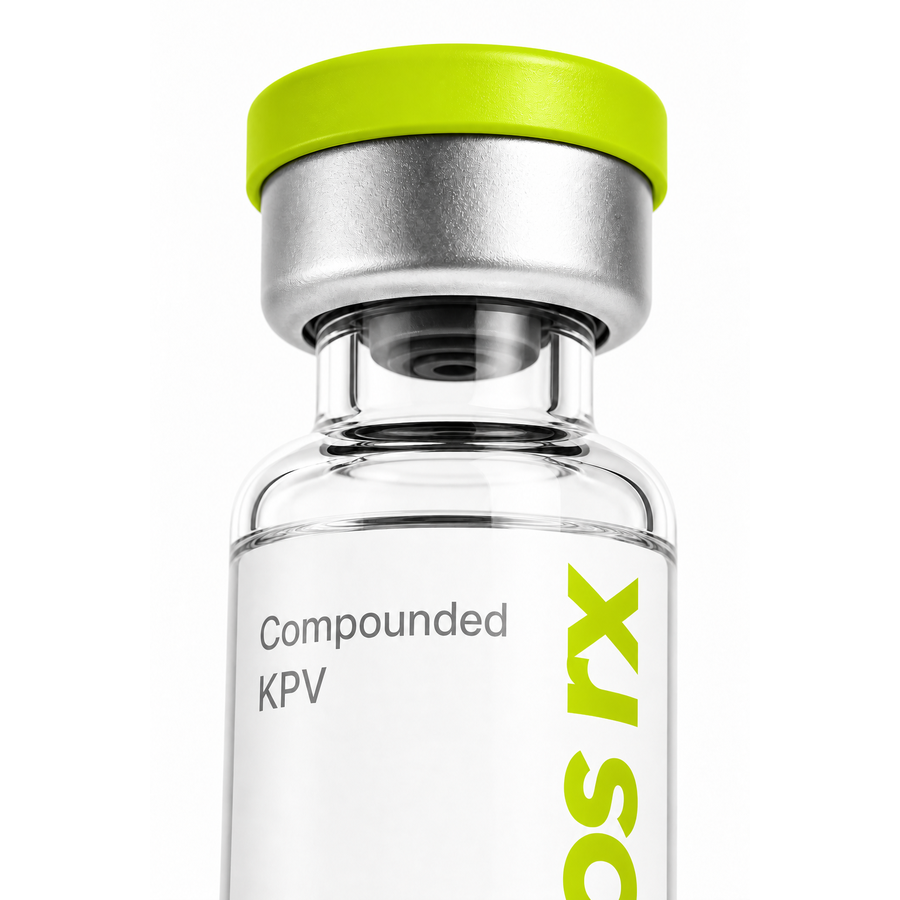
What human safety data exist on KPV side effects?
Very little. KPV is a three-amino-acid peptide (Lys-Pro-Val), the C-terminal fragment of alpha-melanocyte-stimulating hormone, or alpha-MSH. Almost all research on it comes from cell cultures and mice. A PubMed search found no published controlled human trial of KPV, so there are no measured rates for KPV side effects in people.
That matters because animal safety does not always carry over. A molecule can look gentle in mice and still cause problems in people at different doses, over longer periods, or in people with other conditions.
| Source | Model | What it tells us about safety |
|---|---|---|
| Brzoska et al., 2008 | Review | KPV keeps alpha-MSH's anti-inflammatory action but lacks its skin-darkening (pigmentary) effect |
| Laroui et al., 2010 | Cells and mice | KPV nanoparticles did not affect cell viability or gut barrier function in cell tests |
| Xiao et al., 2017 | Cells and mice | KPV-loaded nanoparticles appeared nontoxic and biocompatible with intestinal cells |
| Dalmasso et al., 2008 | Cells and mice | Nanomolar KPV reduced NF-kB signalling and cytokine release, showing it acts on immune pathways |
| Human trials | None found | No published controlled human trial has measured KPV side effects |
One safety-relevant finding is worth knowing. Full alpha-MSH darkens the skin, which limits its use. Reviewers described KPV as keeping the anti-inflammatory activity without that pigmentary effect (Brzoska et al., 2008, Endocrine Reviews). For the science behind the mechanism, see our explainer on KPV anti-inflammatory research.
Questions about KPV side effects and your own health history? A US-licensed provider reviews a short online intake asynchronously, with no scheduled appointment.
See if KPV is right for youReported and theorised KPV peptide side effects
Because there are no trial data, the peptide KPV side effects below come from two places: what people commonly describe online, and what providers reasonably watch for with any compounded peptide. Neither is the same as measured evidence.
| Form people discuss | Reported or theorised effects | Evidence level |
|---|---|---|
| Injection | Redness, swelling, itching or soreness at the site; infection risk if sterility is poor | Theorised from peptide injections generally |
| Oral | Stomach upset, nausea or loose stools | Anecdotal and theorised |
| Topical | Local irritation, redness or contact sensitivity | Anecdotal and theorised |
| Any form | Allergic reaction, rare but possible with any compounded product | Theorised |
Form matters. At telos rx, your provider sets the dose, form and schedule. Our planned guide on oral KPV vs injection compares how the routes differ.
Is a reaction always caused by KPV?
Not necessarily. Gut and skin symptoms change on their own, and people often start several products at once. Our article on KPV Reddit reviews explains why personal reports are hard to read. If something worries you, contact your provider rather than guessing.
Immune-modulation considerations and KPV side effects
KPV is studied precisely because it calms inflammatory signalling. In human gut and immune cell lines, nanomolar KPV inhibited NF-kB and MAP kinase pathways and reduced pro-inflammatory cytokine release, and it entered cells through the PepT1 transporter (Dalmasso et al., 2008, Gastroenterology). In human airway cells, KPV blocked a step that lets NF-kB enter the nucleus (Land, 2012).
That is useful in a lab model of inflammation, and it is why KPV peptides attract interest. In a person, inflammation is also part of fighting infection and normal immune balance. Nobody has shown that KPV weakens immune defences in humans, but the theoretical question is real. That is why people with autoimmune conditions, those who are immunosuppressed, and anyone on immune-modifying medicines should discuss KPV with their provider before starting.
Mouse studies also hint that KPV's effects are not all routed through one receptor. In colitis models, its benefits appeared partly independent of the MC1R receptor (Kannengiesser et al., 2008). More pathways mean more unknowns for human safety.
Who should avoid KPV or talk to a provider first
This is the practical part of any discussion of KPV risks. The list is not exhaustive, and your provider may add others.
- Pregnancy or breastfeeding. There are no safety data, so KPV is not appropriate.
- Autoimmune disease. KPV acts on inflammatory signalling, so discuss it with your provider and specialist first.
- Immunosuppression. If you take immunosuppressants, biologics or steroids, or have a weakened immune system, your provider needs the full picture.
- Active infection. Damping inflammation during an infection is a theoretical concern worth raising.
- Diagnosed IBD. Never stop or change prescribed IBD treatment to try KPV. Talk to your gastroenterologist.
- Under 18. KPV is not studied in young people.
- Tested athletes. Check the current WADA list and your federation first.
KPV is not specifically named on the WADA Prohibited List as far as we can find, but WADA bans non-approved substances under section S0. If you are tested, check before you consider it.
A provider review is the safety step forums skip. KPV at telos rx is compounded by a licensed US pharmacy and prescribed only after an online provider review of your history and medicines.
Learn about the KPV protocolGrey-market contamination: the hidden KPV risk
For many people the largest of the KPV risks is not the molecule but the product. Vials, capsules and creams sold as research use only are made without medical oversight. Their identity, purity, dose and sterility are unverified.
A 2026 review of peptide use in sport and bodybuilding warned that the largely unregulated supply chain means products are often mislabeled or contaminated (Coutinho et al., 2026). For an injected product, poor sterility can mean infection. For any form, the wrong dose or an unknown contaminant can cause side effects that have nothing to do with KPV itself.
Paperwork alone is not reassurance. Our guide on how to read a peptide COA explains what a certificate of analysis can and cannot show.
How a provider screens you before prescribing KPV
Good screening is the best tool for limiting KPV side effects. At telos rx, the process is online and asynchronous:
- Online intake. You answer questions about your conditions, medicines, allergies and goals.
- Provider review. A US-licensed provider reviews your answers, with no scheduled appointment, and checks for reasons KPV may not suit you. A prescription is required, and approval is not guaranteed.
- Licensed pharmacy. If appropriate, a licensed US pharmacy compounds KPV. Your provider sets the dose, form and schedule.
- Follow-up. You can message the care team about any reaction or question.
There is no established human dose for KPV, and online dosing charts are not evidence-based. The planned guide on how providers dose KPV explains the approach. Full details are on the KPV page.
Regulatory status and safety oversight
KPV is not FDA-approved for any use, and compounded KPV has not been evaluated by the FDA for safety, effectiveness or quality. In July 2026, the FDA's Pharmacy Compounding Advisory Committee voted 8 to 6, with one abstention, to recommend adding KPV to the bulk substances list for compounding. FDA's briefing documents had recommended against, and the vote is non-binding, pending FDA rulemaking. On October 28, 2026, HHS announced an interim enforcement discretion policy covering KPV in topical and oral forms only, not injectable KPV. Under it, HHS does not intend to take enforcement action against state-licensed pharmacies that compound single-ingredient KPV with a valid prescription, if conditions such as FDA-registered suppliers, lot testing and adverse event reporting to FDA MedWatch are met. It is temporary, it is not FDA approval, and HHS can revisit it if safety or quality problems arise. Our PCAC vote explainer covers the details, and the planned guide on KPV legal status will track it.
Summary: KPV side effects at a glance
KPV side effects have not been measured in human trials, so nobody can give you reliable rates. Lab and mouse work suggests low toxicity to gut cells, but KPV acts on immune signalling, which raises theoretical questions for people with autoimmune disease, immunosuppression or infections. Pregnancy and breastfeeding are reasons to avoid it. Grey-market products add contamination risk. If you are considering KPV, start with a licensed provider review.
KPV side effects FAQ
What are the most common KPV side effects?
Nobody knows for certain, because KPV side effects have not been measured in controlled human trials. The effects people mention, or that providers watch for, depend on the form: redness or irritation where a product is applied or injected, stomach upset with oral forms, and the rare possibility of an allergic reaction.
Is KPV safe?
There is not enough evidence to call KPV safe or unsafe in people. In cell and mouse studies KPV-loaded particles did not appear toxic, but that does not establish human safety. KPV is not FDA-approved, so a licensed provider should weigh your history before you use it.
Are KPV peptide side effects different by form?
Likely, yes. Injected, oral and topical products expose the body differently, so local reactions differ. KPV peptide side effects for any form are poorly documented, which is why your provider sets the dose, form and schedule and reviews how you respond.
Does KPV affect the immune system?
In lab studies KPV reduced NF-kB signalling and inflammatory cytokines, which is the reason it is studied. Dampening inflammation is a theoretical consideration for people with infections, autoimmune disease or immunosuppression, so they should discuss KPV with their provider first.
What are the biggest KPV risks?
The biggest practical KPV risks are unknown long-term effects, possible interactions with immune-related conditions or medicines, and product quality. Grey-market research use only products are unverified and may be mislabeled or contaminated.
Who is most at risk of KPV side effects?
People who are pregnant or breastfeeding, and people under 18, should not use KPV because there are no safety data. People with autoimmune disease, those who are immunosuppressed, and anyone on immune-modifying medicines should discuss it with their provider first.
How does telos rx screen for KPV safety?
You complete an online intake covering your health history and medicines, which a US-licensed provider reviews asynchronously. If appropriate, a licensed US pharmacy compounds KPV and your provider sets the dose, form and schedule. It is subject to medical approval by a licensed provider, and approval is not guaranteed.
Now you know what is and is not known about KPV safety. If you want a licensed provider to decide whether KPV fits your health history, start a short online intake.
Explore KPV at telos rxThis article is for general education and is not medical advice. KPV is not FDA-approved for any use, and compounded KPV has not been evaluated by the FDA for safety, effectiveness or quality. All prescriptions are subject to medical approval by a licensed provider; approval is not guaranteed. Individual experiences vary. Seek urgent care for any severe reaction. telos rx is an online-first, asynchronous telehealth service, and medications are compounded by a licensed US pharmacy. Tested athletes should check the current WADA Prohibited List.