
Oral KPV is plausible in research because KPV is a tiny three-amino-acid peptide that gut cells can absorb through a transporter called PepT1. In mice, KPV given by mouth, including inside nanoparticles, reduced signs of colitis. Whether oral KPV works in people, or how it compares with an injection, has not been tested in published human trials.
Most peptides are a poor fit for swallowing. Digestive enzymes break them apart, and the gut wall keeps large molecules out. So why do so many people search for oral KPV and KPV capsules? This guide explains the science behind the idea, what the mouse studies did, what is still unknown in humans, and why grey-market capsules are a gamble.
Also searched as: kpv capsules, kpv oral vs injection, oral kpv peptide, kpv peptide pills.
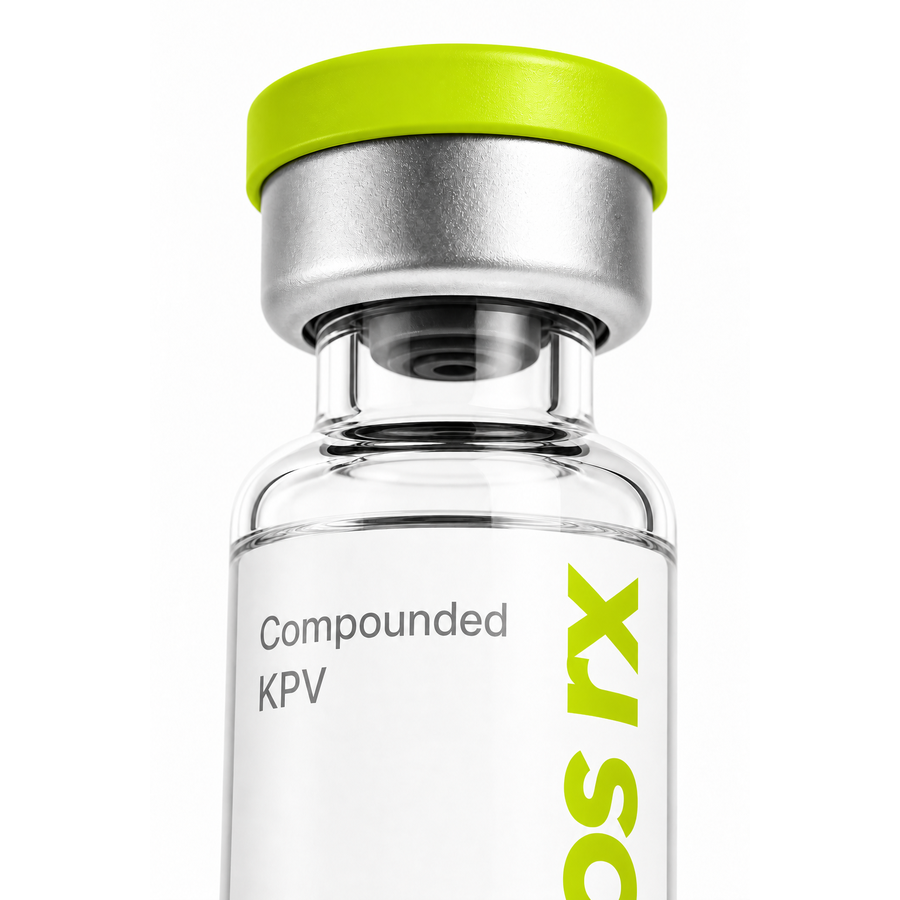
What is the KPV peptide?
KPV is a tripeptide made of lysine, proline and valine. It is the C-terminal fragment, positions 11 to 13, of alpha-melanocyte-stimulating hormone, or alpha-MSH (Kannengiesser et al., 2008). The KPV peptide is studied for anti-inflammatory signalling, especially in the gut. Our guide on what the KPV peptide is covers the basics, and our review of KPV gut health and IBD research goes deeper into the colitis studies.
Its size is the reason oral KPV comes up at all. Three amino acids is about as small as a peptide gets, which sets peptide KPV apart from larger molecules such as insulin.
Why oral KPV is plausible: size and PepT1
Your small intestine absorbs protein from food partly as tiny fragments, two or three amino acids long. It does this with a transporter called PepT1, which pulls dipeptides and tripeptides into the cells lining the gut. PepT1 is normally found mainly in the small intestine, and research suggests it is switched on in the colon during inflammatory bowel disease (Dalmasso et al., 2008, Gastroenterology).
KPV is a tripeptide, so it fits that route. In a 2008 study, researchers showed that KPV was taken up by human gut and immune cells through PepT1. At very small, nanomolar concentrations, it reduced activation of NF-kB and MAP kinase inflammatory pathways and lowered inflammatory cytokine release in those cells (Dalmasso et al., 2008).
A later paper noted that PepT1 had a relatively high affinity for KPV in that earlier cell work, describing it as among the lowest Km values reported for the transporter, which means it binds KPV well (Viennois et al., 2016). The same paper found KPV's protective effect in mice largely depended on PepT1, though it suggested other transporters might also play a part.
That is the core case for oral KPV: a peptide small enough, and attractive enough to a gut transporter, to stand a chance of getting in.
Curious whether KPV fits your health history? Complete a short online intake. A US-licensed provider reviews it asynchronously, with no scheduled appointment, and decides whether KPV is appropriate for you.
See if KPV is right for youWhat oral KPV studies in mice showed
The oral KPV research is almost entirely in mouse models of colitis. Here is what the main studies did.
| Study | Oral approach | What was reported in mice |
|---|---|---|
| Dalmasso et al., 2008 | KPV in drinking water | Reduced colitis and lower inflammatory cytokine expression in two models |
| Laroui et al., 2010 | KPV in about 400 nm nanoparticles, inside an alginate and chitosan gel | Protection against colitis at a concentration about 12,000-fold lower than free KPV |
| Xiao et al., 2017 | Hyaluronic acid-coated KPV nanoparticles in a hydrogel | Less mucosal damage and lower TNF-alpha than uncoated KPV nanoparticles |
| Viennois et al., 2016 | KPV in drinking water | Fewer colitis-associated tumours, an effect lost in mice lacking PepT1 |
Why nanoparticle delivery matters for oral KPV
The nanoparticle studies tried to solve a delivery problem. Free peptide in the gut can be diluted, broken down or absorbed before it reaches the inflamed colon. In the 2010 study, the gel coating was designed to collapse in the colon and release the particles there, where they released KPV close to the colon's lining cells (Laroui et al., 2010). The 2017 study added a hyaluronic acid coating to steer the particles towards gut lining cells and immune cells called macrophages (Xiao et al., 2017).
Researchers have also used KPV itself as a targeting tag on nanoparticles that carry other drugs, because of its affinity for PepT1 (Wu et al., 2019). That shows how seriously the field takes the PepT1 route, but those are experimental drug-delivery systems, not products you can buy.
Oral KPV vs injection: what is known and what is not
People searching "kpv oral vs injection" usually want a simple winner. The honest answer is that nobody has compared them in humans. Here is how the two routes differ in principle.
| Question | Oral KPV | Injected KPV |
|---|---|---|
| Where research focused | The gut lining, in mouse colitis models | Little published injection research to compare |
| Main hurdle | Surviving digestion and reaching the right part of the gut | Needs sterile preparation and correct injection technique |
| Formulation used in studies | Water solutions or engineered nanoparticles | Not established for humans |
| Human trial data | None published | None published |
What is not known about oral KPV in humans
- How much is absorbed. Human absorption of oral KPV has not been measured in published trials.
- Whether it reaches the colon. The mouse nanoparticles were engineered for that. A plain capsule is not.
- Effects outside the gut. Mouse oral studies looked at colitis, not skin, joints or whole-body inflammation.
- Safety over time. There are no long-term human safety data for any form of KPV. Our planned guide on KPV side effects and safety covers what is reported.
- The right dose. There is no established human dose for any route. Our guide on KPV dosage and how providers dose explains why online numbers are not evidence-based.
The oral vs injection question is not one you have to solve alone. KPV at telos rx is compounded by a licensed US pharmacy and prescribed only after an online provider review.
Learn about the KPV protocolGrey-market KPV capsules: what you are actually buying
Search for KPV capsules or other KPV peptides online and you will find products labelled "research use only." That label means they are not sold for human use and come with no medical oversight. Their quality is unverified.
Three problems stand out with grey-market oral KPV:
- Content. A capsule may contain less KPV than claimed, more than claimed, or a different substance.
- Formulation. Plain powder in a capsule is not the engineered nanoparticle system used in mouse research, so study results do not carry over.
- Paperwork. A certificate of analysis can be missing, outdated or unrelated to the batch in your hand. Our guide on how to read a peptide COA explains what to look for.
None of this means oral KPV is useless. It means a grey-market capsule tells you very little about what you are taking.
How a provider approaches KPV form
Because oral KPV and injected KPV have not been compared in people, form is a medical decision. At telos rx, the process is online and asynchronous:
- Online intake. You share your health history, medications and goals.
- Provider review. A US-licensed provider reviews it without a scheduled appointment. A prescription is required, and approval is not guaranteed.
- Dose, form and schedule. If KPV is appropriate, your provider sets the dose, form and schedule.
- Licensed pharmacy. A licensed US pharmacy compounds the prescription.
Full details are on the KPV page. If you are weighing KPV against another peptide, our KPV vs BPC-157 comparison may help, and telos rx also offers BPC-157.
Oral KPV legal status and sport
KPV is not FDA-approved in any form, and compounded KPV has not been evaluated by the FDA for safety, effectiveness or quality. In July 2026, the FDA's Pharmacy Compounding Advisory Committee voted 8 to 6, with one abstention, to recommend adding KPV to the list of bulk substances for compounding, against the recommendation in FDA's briefing documents. The vote is advisory and non-binding, pending FDA rulemaking. Since October 28, 2026, a temporary HHS enforcement discretion policy covers compounded KPV in topical and oral forms only; injectable KPV is not covered, and oral products must be supported by documentation of adequate oral bioavailability in humans. It is not FDA approval, and HHS can revisit it. See our PCAC vote explainer and the planned guide on whether KPV is FDA-approved.
For athletes, KPV is not named on the WADA Prohibited List as far as we know, but section S0 covers substances not approved for human therapeutic use. Tested athletes should check the current WADA list and their federation.
Summary: oral KPV in plain terms
Oral KPV makes scientific sense on paper. KPV is small, and gut cells appear to absorb it through PepT1. Mouse studies using drinking water and nanoparticles reported less colitis. But no human trial has tested oral KPV, compared it with an injection, or set a dose. Grey-market KPV capsules add a quality problem on top. If you want to explore KPV, the telos rx KPV page explains how a provider reviews it.
Oral KPV FAQ
Does oral KPV work?
Oral KPV has only been studied in mice. In those studies, KPV given in drinking water or inside nanoparticles reduced markers of gut inflammation in colitis models. Whether oral KPV does anything comparable in people has not been tested in published controlled human trials.
Why is oral KPV considered plausible when most peptides are not?
KPV is only three amino acids long, and lab work suggests it is carried into gut and immune cells by PepT1, a transporter that normally absorbs small dipeptides and tripeptides from food. Larger peptides cannot use this route. That makes oral KPV plausible in research, but not established in humans.
Are KPV capsules the same as the KPV used in studies?
Not necessarily. The mouse studies used KPV dissolved in water or packed into engineered nanoparticles. Grey-market KPV capsules sold online are not the same formulations, and their content, purity and dose are unverified.
Is oral KPV vs injection a question of strength?
Not simply. Oral KPV and injected KPV reach the body by different paths, so the same amount does not behave the same way. Oral research has focused on the gut lining, while an injection enters the tissue directly. No human study has compared the two routes.
Is the KPV peptide FDA-approved in any form?
No. KPV is not FDA-approved in any form, oral or injectable. In July 2026 an FDA advisory committee voted to recommend adding KPV to the list of bulk substances for compounding, but that vote is advisory and non-binding, and FDA rulemaking is still pending. A temporary HHS enforcement discretion policy announced October 28, 2026 covers compounded KPV in topical and oral forms only, not injection, and it is not FDA approval.
Which form of KPV is right for me?
That is a medical decision. If KPV is appropriate, a licensed provider sets the dose, form and schedule after reviewing your health history, medications and goals. KPV is subject to medical approval by a licensed provider, and approval is not guaranteed.
Is oral KPV safe?
Human safety data for oral KPV are lacking because no controlled human trials have been published. Lab studies reported that the KPV nanoparticle carriers did not harm gut cells grown in culture, but that does not establish safety in people. A provider can weigh the unknowns against your history.
Now you know what the oral KPV research shows and where it stops. If you want a licensed provider to decide whether KPV fits you, and in what form, start a short online intake.
Explore KPV at telos rxThis article is for general education and is not medical advice. KPV is not FDA-approved for any use, and compounded KPV has not been evaluated by the FDA for safety, effectiveness or quality. Animal findings may not apply to people. All prescriptions are subject to medical approval by a licensed provider; approval is not guaranteed. Individual experiences vary. telos rx is an online-first, asynchronous telehealth service, and medications are compounded by a licensed US pharmacy. Tested athletes should check the current WADA Prohibited List.